
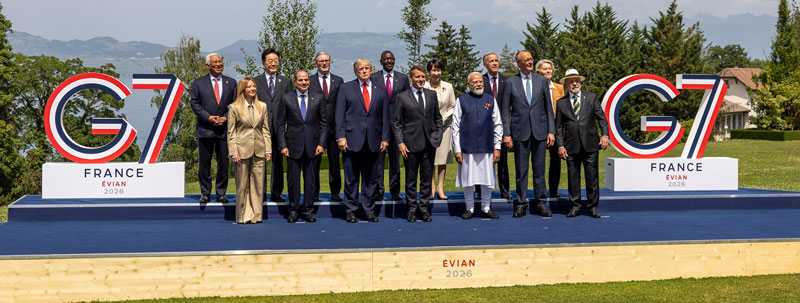
World leaders attending the G7 Summit plan to reduce their countries’ reliance on China for critical minerals by coordinating stockpiles and launching a new platform that expands the role of the International Energy Agency (IEA), according to Reuters.
The news agency noted that global markets were shaken last year when Beijing imposed export restrictions on permanent magnets, disrupting industries and highlighting how heavily they relied on a single source.
Without explicitly naming China, the leaders said they aim to reduce dependence on any one supplier outside the G7 and partner countries for rare earths and permanent magnets to below 60% by 2030, and move toward 50% “as soon as possible.”
“We are committed to working towards establishing harmonized, interoperable mechanisms …. This would start with two pilot critical minerals – lithium and nickel – and aim to avoid undermining competitiveness or imposing excessive cost burdens,” the leaders said in a joint statement.
These mechanisms will gradually expand to cover five new minerals annually, with a particular focus on rare earth elements.
The 60% target will be difficult to reach, analysts said, especially for processed rare earths and magnets, where China currently accounts for 90% of global production.
The G7 will also create a platform to coordinate policy, share data, and manage crisis responses. Working with the IEA, the platform will monitor markets and identify emerging risks, drawing on the agency for analysis and “early warnings of market distortions,” the group said.
The leaders said G7 development finance institutions and export credit agencies should work together, including with the private sector, to support projects and infrastructure. Since the start of 2026, countries have announced 195 projects with $74 billion in investment.
The G7 has also pledged to increase domestic stockpiles of critical minerals across both industrial and public sectors. The United States launched its $12 billion Project Vault critical minerals reserve earlier this year, while the EU has shortlisted tungsten, rare earths and gallium for its first joint stockpile of critical minerals, sources told Reuters.
Lastly, the leaders further committed to scaling up recycling of critical materials, with the goal of ensuring that G7 recycling capacity accounts for a “significant share” of annual consumption by 2030.
Source: Reuters